Sure, you know how to grill a steak, or make a mean rack of ribs, but how well do you really know your gas grill?
Did you know that your barbecue’s grease tray or cup should be emptied on a regular basis? Do you know what those heat plates sitting above the burners actually do? How about the carryover tubes? We bet that some of you answered “No” to one or more of these questions.
Every gas grill will look slightly different, but gas grills generally aren’t very complex machines. Understanding the function of the key components of your barbecue will help you to take better care of your grill, extending its lifetime and saving you money in the long run.
We’ve created this handy gas grill “anatomy chart” to help you understand the most important parts of your gas grill. School’s in, so come on and get to know your grill.
Even the simplest gas grill is more complex than a typical charcoal grill. Common components of a gas grill include:
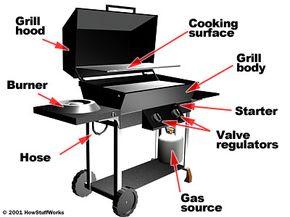
- Gas source
- Hoses
- Valve regulators
- Burners
- Starter
- Cooking surface
- Grill body
- Grill hood
The grill body houses all of the other components except the hood. The hood covers the cooking surface and serves to trap the heated air inside, which increases the temperature inside the grill.
The gas source is connected to the valve regulators via the main hose. The regulators are controlled by knobs that allow you to determine how much gas is allowed through the valve to the burner. Most grills have two main burners, with a regulator for each one. Each burner has a series of tiny holes along its length that the gas exits through.
Types of gas grill parts:

Cooking Grate
Cooking grates are the workhorse of your grill. They are exposed to the most wear and tear of any part on your barbecue and for that reason require regular care and maintenance such as cleaning and seasoning.


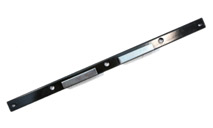

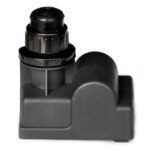


Take a look at our infographic to see where you might find each of these parts on your grill:
